St Augustine’s Church is a comparatively new church. It is not yet 100 years old. Crawford Norris wrote the first history; a scanned copy is found near the bottom of this page. This page draws on that history, but supplements it from other sources discovered within St Augustine’s or in various archives and histories.
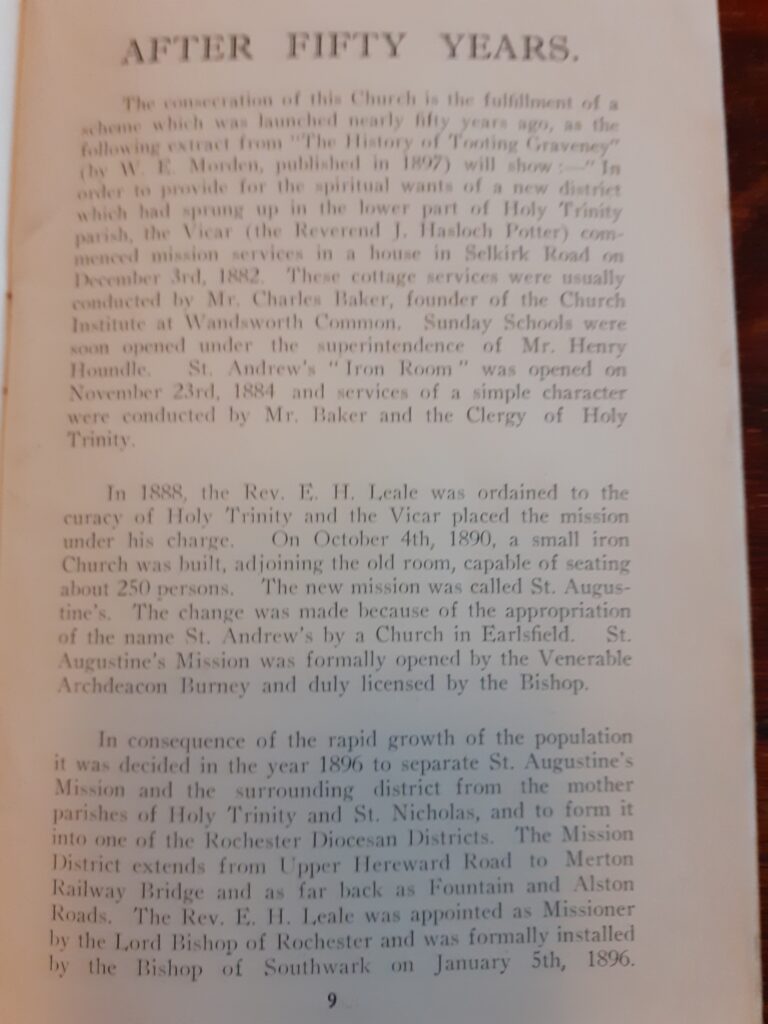
In order to meet the spiritual wants of a new district which had sprung up in the lower part of Holy Trinity parish, the Vicar (Rev. J. Hasloch Potter) commenced mission services in a house in the Selkirk Road [now Khama Rd], on December 3, 1882. These cottage services were usually conducted by Mr. Charles Baker, founder of the Church Institute, Wandsworth Common. Sunday Schools were soon opened under the superintendence of Mr. Henry Houndle.
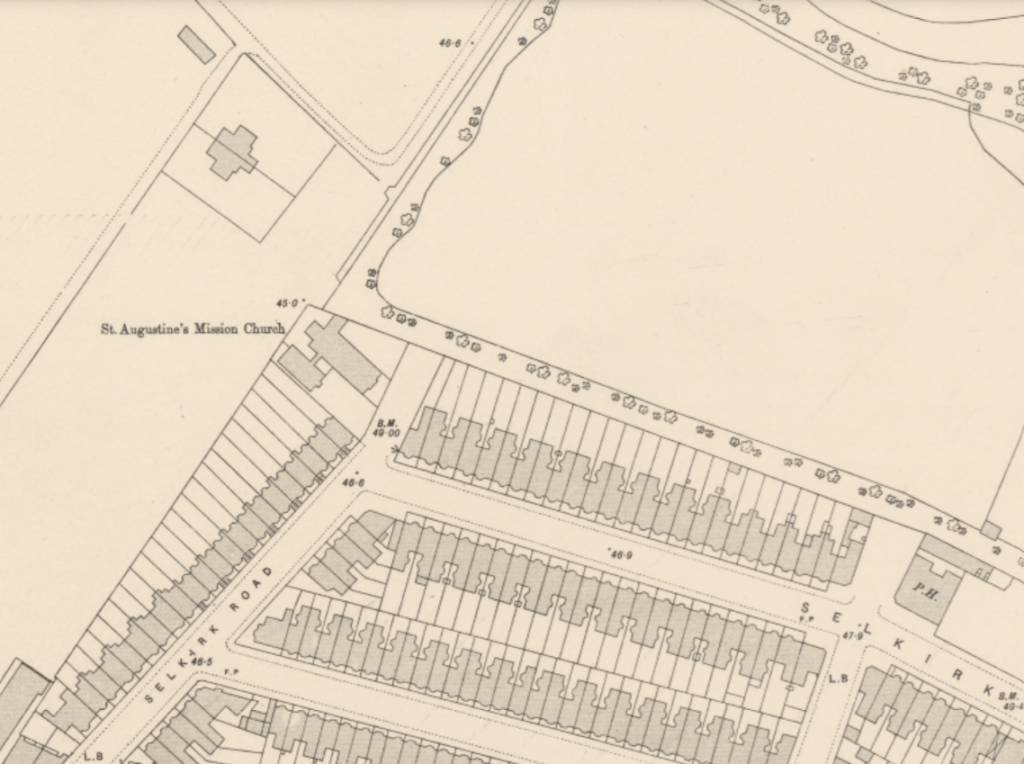
St. Andrew’s Iron Room was opened November 23, 1884, and services of a very simple character were conducted by Mr. Baker and the clergy of Holy Trinity.
In 1888 the Rev. Edward Henry Leale was ordained to the curacy of Holy Trinity, and the mission was by the Vicar placed especially under his charge.
On October 4 1890, a small iron church was built [possibly on site of 49 Khama Rd], adjoining the old room, and capable of seating about 250 persons. This new mission was called St. Augustine’s, in honour of the first Archbishop of Canterbury. The change was made because of the appropriation of the name St. Andrews by a church in Earlsfield.
St. Augustine’s mission was formally opened by the Venerable Archdeacon Burney, and was duly licensed by the Bishop. In consequence of the rapid growth of the population, it was decided in the year 1896 to separate St. Augustine’s mission and the surrounding district from the mother parishes of Holy Trinity and St. Nicholas and to form it into one of the Rochester Diocesan Districts.”
p335 – “The History of Tooting-Graveney: Surrey”
“The Rev. E. H. Leale was appointed as the Missioner by the Lord Bishop of Rochester, and was formally installed by the Bishop of Southwark on January 5, 1896.”
p336 – “The History of Tooting-Graveney: Surrey”.
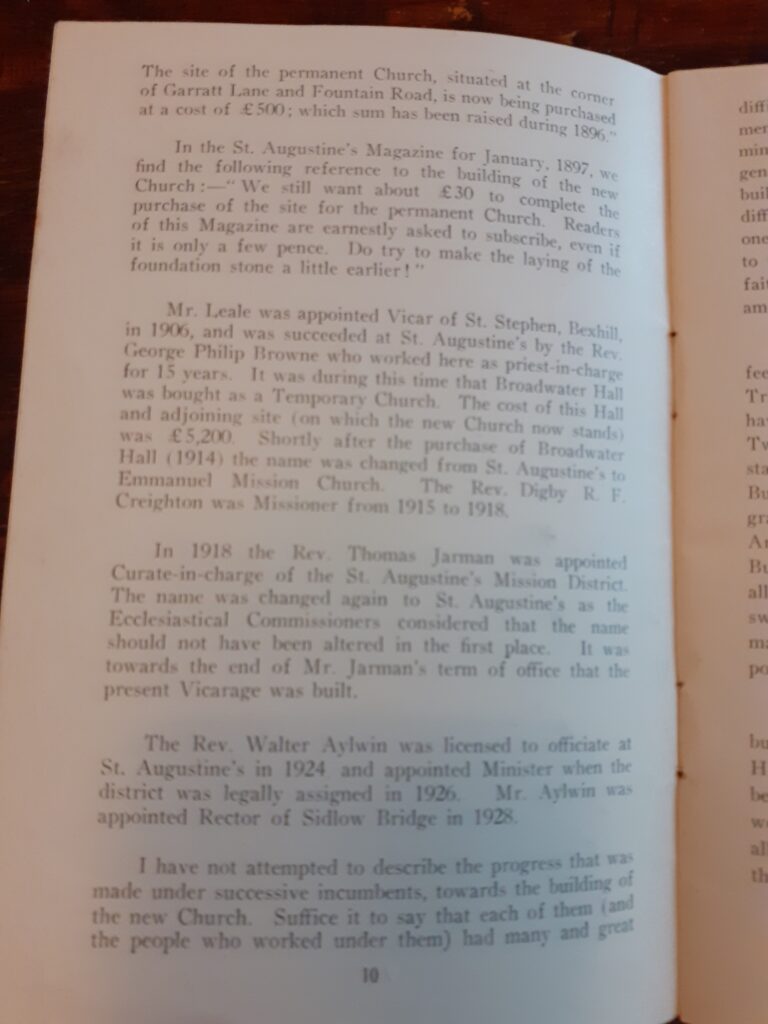
The History also refers to a “site for the permanent church, situated at the corner of Garratt Lane and Fountain Road” as “being purchased”, and there are 1897 deeds (Lambeth Palace Library) showing the purchase of this property “for the site of and for an intended new Church to be called the Church of St Augustine Tooting with surrounding yard and enclosure thereto and to be devoted when consecrated for Ecclesiastical purposes forever….”
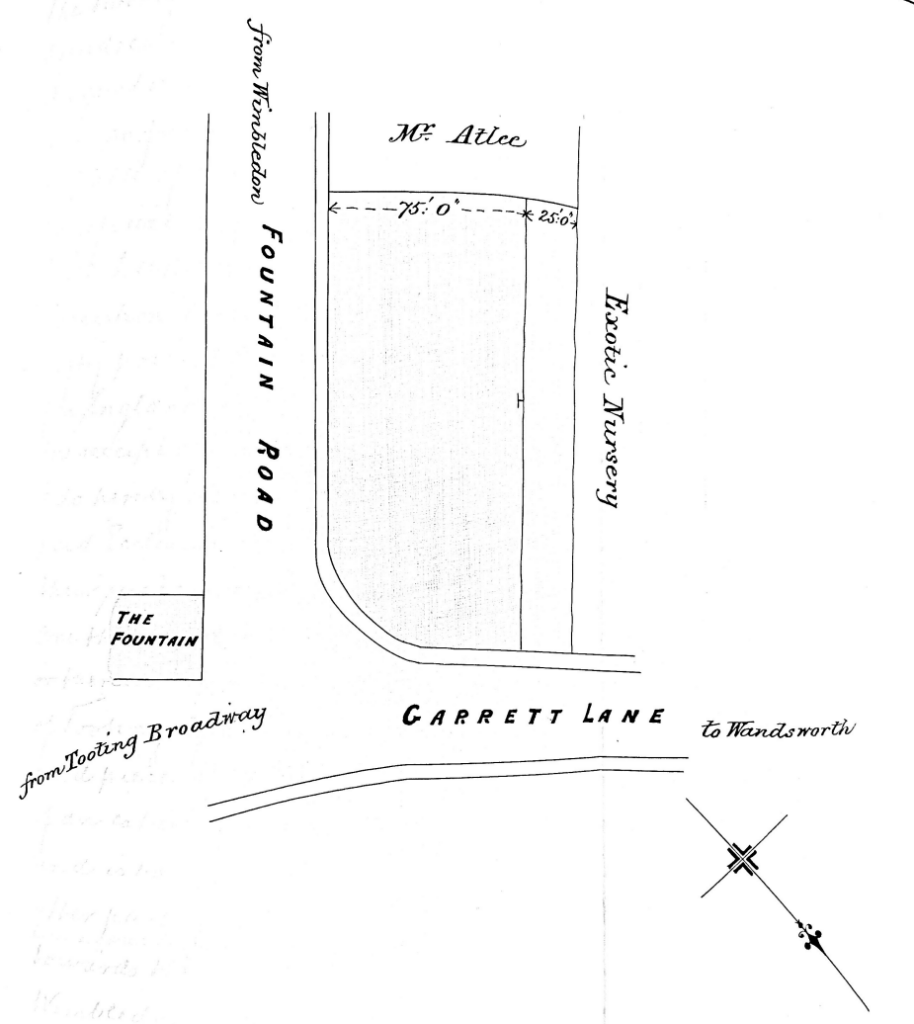
(This is not to be confused with the mission hall marked on the 1893/5 maps on the corner of Garratt Lane and Broadwater Road which is nearby, but appears thus far to be unrelated to St Augustine’s).
There are a two other sets of deeds dated 1900 (both lodged in Lambeth Palace Library as ECE/6/3/408/CD30967 and ECE/6/3/409/CD31047), which may indicate additional or alternative sites planned for St Augustine’s Church. In the 1896 Kelly’s London Suburban Directory, two sets of rooms are mentioned in Selkirk Road; St Andrew’s Mission Rooms & St Augustine’s Mission Rooms, as well as Holy Trinity Mission Room on Tooting Bec Road.
The Rev’d Leale appears to have left Tooting to be Vicar of St Stephen’s Bexhill at some point in 1900 (Church Times Obits Sept 5, 1958). (Crawford Norris’ history states he left in 1906, but this appears to be an error).
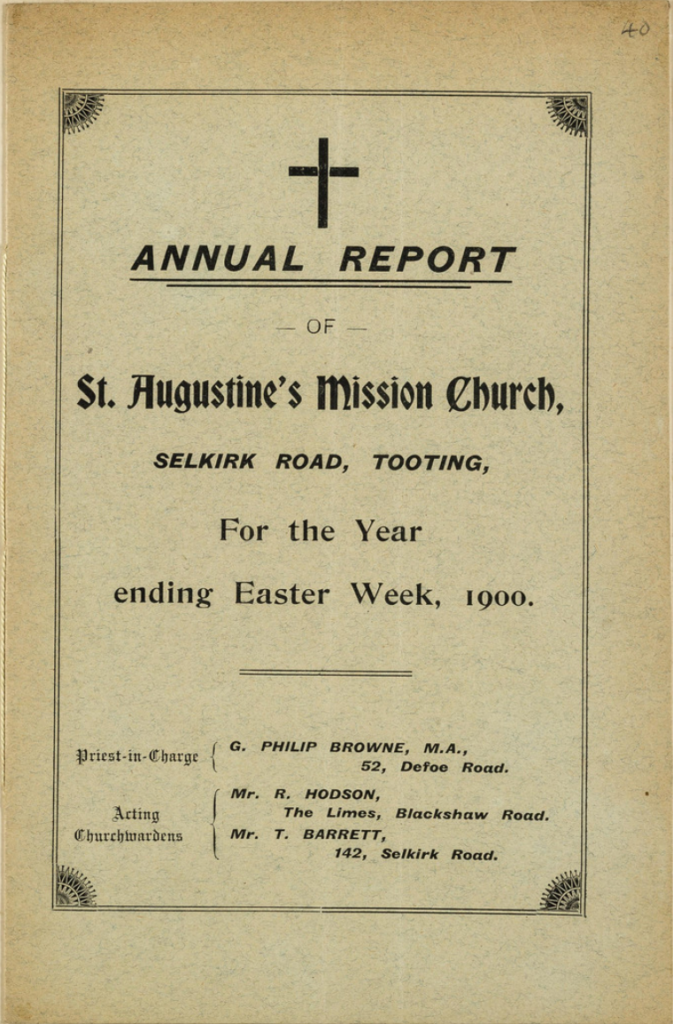
The first information we have about Rev’d G. Philip Browne and his work at St Augustine’s is found in Charles Booth’s notebook, “Clergy in Norwood, Streatham, Tooting etc District 40” p27f in an interview dated 11th December 1900, as follows:
“Mr Browne is a man of middle age who has been here only since March last. Previously he had been for eight years Curate to his brother at St Andrew’s, Stockwell.”
The Population of the Mission District is from 2500 to 3000, all working class; tradesmen, bricklayers, carpenters and labourers, already living two families to a house. The extensive building in the neighbourhood has drawn the men of the building trade here in large numbers. There is plenty of work at present and ought to be little poverty: nor is there much in the parish but there is a good deal of [illegible] and squalor in the new streets of the adjoining parish of Tooting Graveney.
The Church (of iron) holds 250: in the morning, there are “very few”: in the evening about 150. The Communicants on Easter Sunday were 93. All who are coming are working class; the Churchwardens are a bricklayer and a foreman in the Army & Navy stores. Those who attend at [illegible] were very attached. Mr B’s brother from Stockwell officiated last Sunday and thought this was “a hearty sermon and a good proportion of men”.
At the Thursday service there are from 20-30, “only the faithful”.
Owing to the difficulty of getting lady workers the district has never been properly visited. Mr Browne can manage [illegible] but the sick : but wherever he has been, the people have been polite.
Relief to the amount of about £40 is administered by Mr B himself. There is no C. O. S [Charity Organisation Society] committee in this district.
Of other other agencies the only effective one is the Congregational Church in High Road. Mr(?) Allan(?) is very popular and has a [illegible] Roger [illegible].
As to general questions Tooting has a bad name for drink. It has in part a very rough population which has “overflowed from Battersea”. Mr B lives in Defoe Road which is the main throroughfare from the high road to the poor streets about the Cemeteries. He complains greatly of the shouting and singing of drinkers returning home, and thinks there an insufficient police.
This appears to me rather a feeble Mission Church, and Mr B though a very pleasant fellow is scarcely the man to make much of it.
This is followed by a pamphlet printed in 1900 by St Augustine’s in which The Rev’d G.P. Browne mentions The Rev’d Edward Leale’s departure, and commends his work.
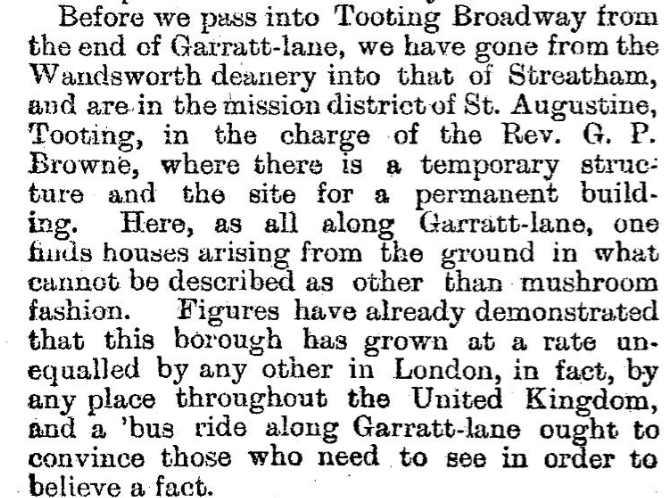
[In future… hope to discover/add more here about G. P Browne, as there is scant information available from between 1900/01 and the March 1916 parish magazine.
<- Church Times Article 14/2/1902 p 187
The leader of the March 1916 edition of the St Augustine’s Parish magazine quotes from the Wandsworth Borough News (October 17 1915) which refers to a Rev. G. P. Browne (along with a band of voluntary helpers) having laboured in the parish for 15.5 years, and (separately) a Major and Mrs Nott having laboured for eight years at Broadwater Hall “on interdenominational lines”.
It also mentions that the Broadwater Hall was then purchased from the Notts (along with the adjoining church site) and licensed for services by the Bishop of Southwark on Thursday October 14th, 1912. (Source Mar 1916 Parish Magazine)
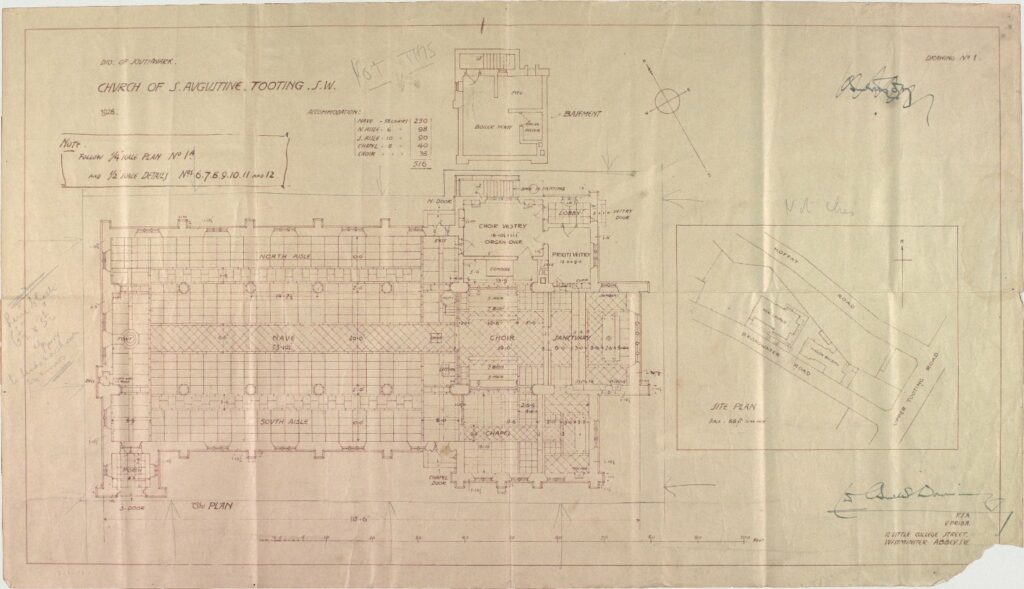
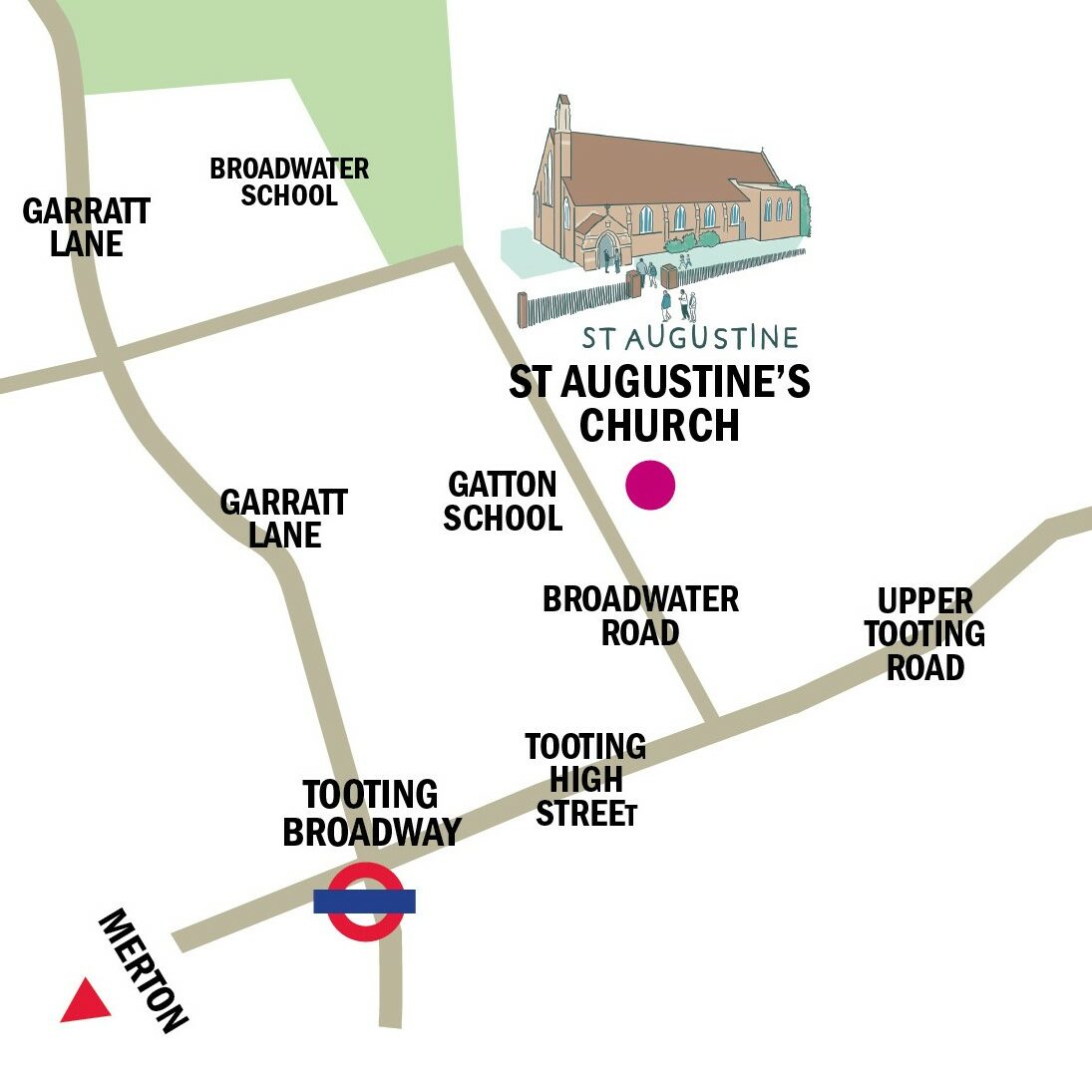
“A hall in Broadwater Road was bought in 1914 for use as a temporary church for St Augustine’s Mission. An adjoining site for a permanent church was acquired at the same time, giving a total road frontage of 190 feet.”
p165 of “The “Twenty-five churches of the Southwark Diocese” by Kenneth Richardson (c) 2002
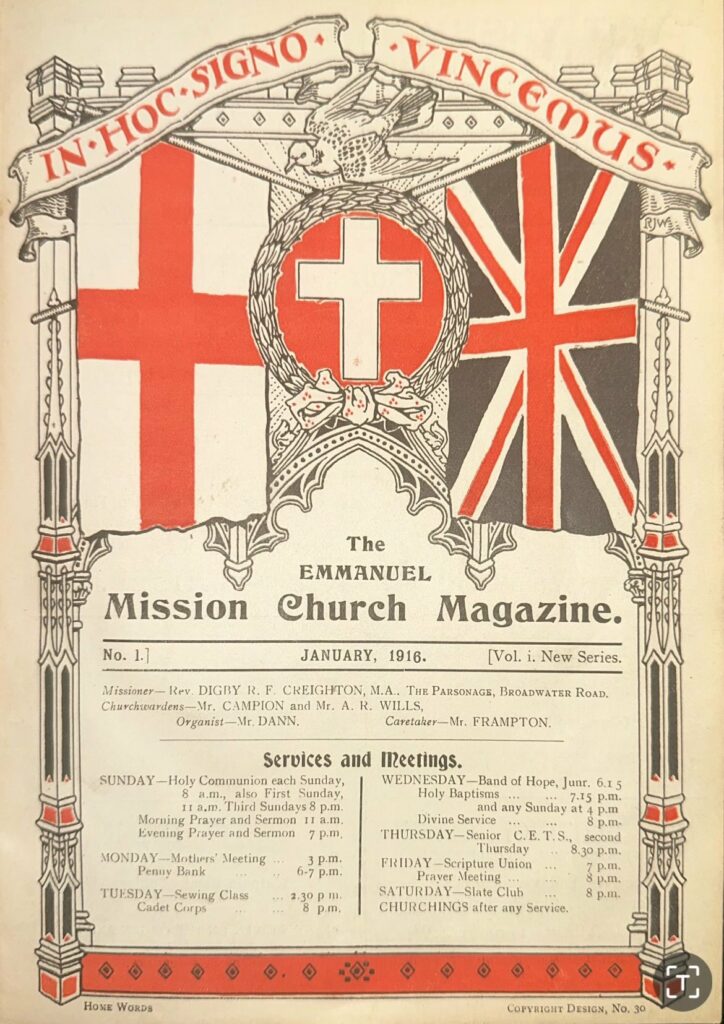
In October 1915, The Rev. Digby Creighton was appointed as Missioner and Vicar Designate of the Mission District of St Augustine’s and Broadwater Hall Tooting, where he remained until 1918. It appears he attempted to name the hall “Emmanuel Mission Church” (March 1916 parish magazine), on the basis that the St Augustine’s church (on Selkirk/Khama Road) had been sold, and the hall was a new entity.
According to “Twenty-five churches of the Southwark Diocese” (and Crawford Norris’ history), in 1918 the dedication reverted to St Augustine’s. However, the 1920 parish magazine is still entitled “Emmanuel Church Magazine”.
In 1918 Thomas Jarman was appointed as curate-in-Charge; he wrote his first piece for the January 1919 Parish Magazine, but refers to Christmas services, so presumably arrived at the back end of 1918. He focused upon the restoration of Christian life following the end of the first World War. In June 2019 (according to the parish magazine of that year), he began appealing for £25,000 to build a Mission House and Church. The Church Times 1923 (Sept 21st) makes mention of Thomas Jarman leaving to go to be Vicar of Christ Church Bermondsey.
“The first development on the new site was the erection of a parsonage, built in 1923 by G. P & H Barnes of Streatham to the designs of H. P. Burke Downing… p165 of “The “Twenty-five churches of the Southwark Diocese”.
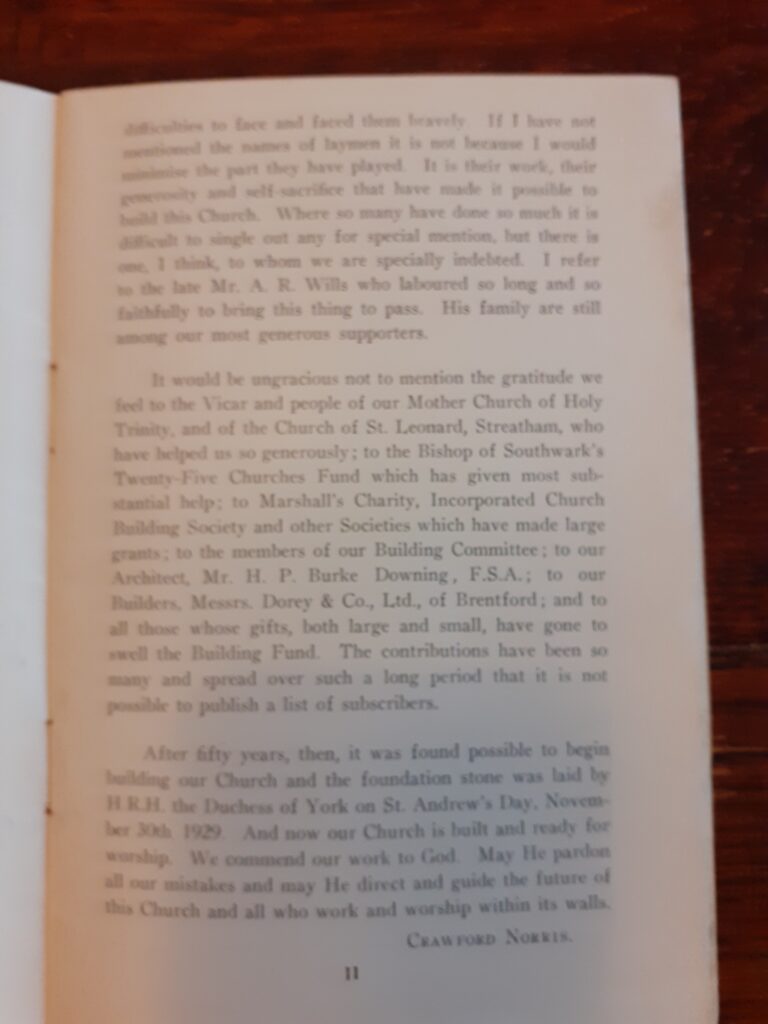
In 1924, The Rev’d Walter Aylwin was licenced to officiate. (Crawford Norris history)
Then “[In 1924] Bishop Garbett warned that the District was growing rapidly and would need a parochial status within a few years. In 1926 the Order in Council was made… The Bishop of Southwark was awarded the patronage of the living by virtue of his having contributed £2,000, with the promise of £2,000 more, from the Twenty-give Churches Fund towards the cost of erecting a permanent Church.”
p165 of “The “Twenty-five churches of the Southwark Diocese” by Kenneth Richardson (c) 2002 “
According to Crawford Norris, The Rev’d Walter Aylwin was appointed Missioner in 1926 when the district was legally assigned, but left in 1928.
A plaque above the south entrance door commemorating Crawford Norris notes that he was Vicar from 1928.
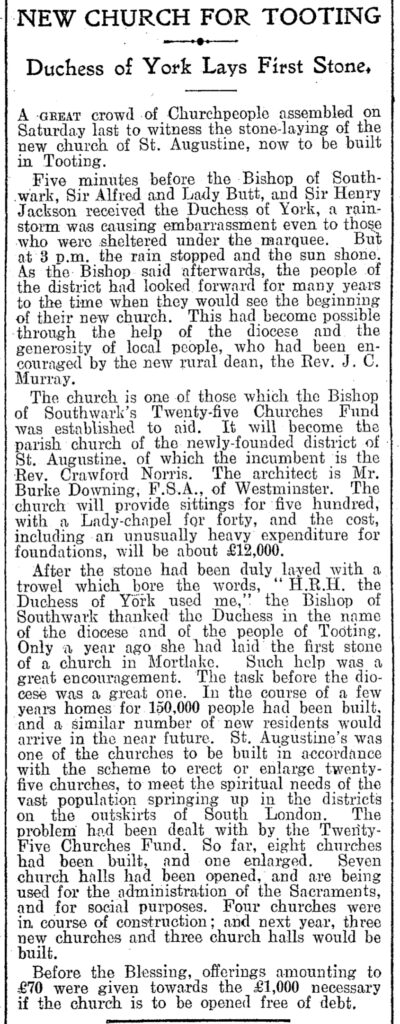
The foundation stone for the present St Augustine’s Church (at 16-18 Broadwater Road) was laid on Saturday November 30th, 1929. (St Andrew’s Day).
<- Church Times, Fri 6 Dec 1929 p695
[More history yet to be added here for St Augustine’s related events following 1929…]
Type something here to divide the blocks up